
Stranger
by Jorge Javier Peña
The First Like From a Stranger
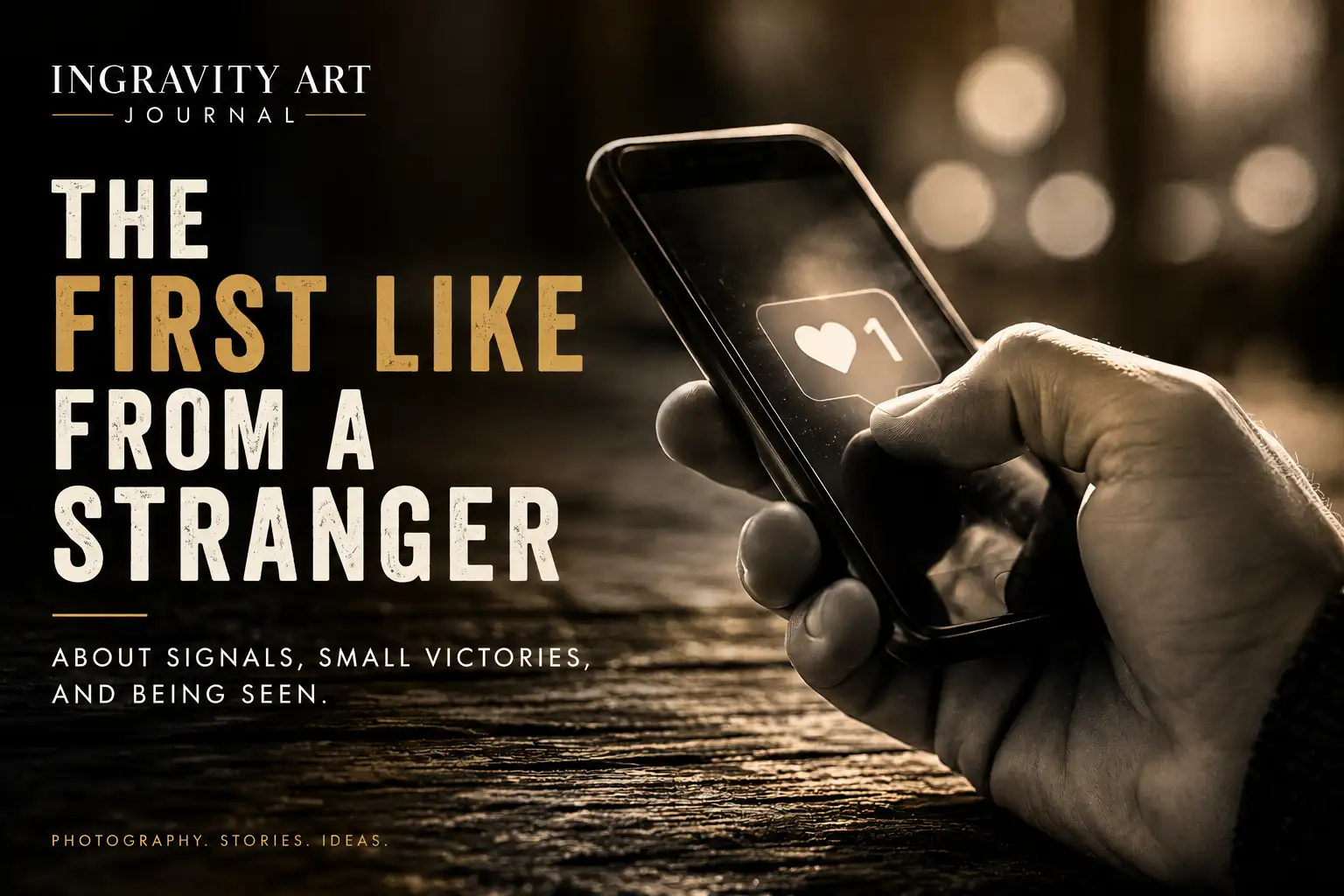
I still remember getting my first like on Instagram. No heavenly trumpets played. Money didn’t fall from the sky. No Norwegian model appeared asking me to shoot a campaign in Santorini. It was just a tiny notification on a screen. A stranger saw something I posted and paused for a moment.
I know. It sounds ridiculous.
But I promise you, it wasn’t.
Because creating things is, at its core, a way of sending signals. You post photos, write strange ideas, invent projects that would probably concern a serious psychologist, and underneath all that noise, there’s a question you don’t always dare to say out loud: is there anybody out there? Meanwhile, the algorithm stares back at you with all the enthusiasm of a bank clerk reviewing a deposit slip. No reaction. No expression. Just that face that says: next.
Nothing happens.
And then one day, somebody appears.
Not your mom saying “beautiful, my love” even if the photo is crooked. Not that loyal friend who likes your blurry picture of a sandwich just because they genuinely care about you. Not even the secret admirer everybody already knows about. No. A stranger. Somebody who owes you no affection, no patience, no emotional support whatsoever. Someone with absolutely no reason to stop.
And yet they stopped.
They saw what you made. What you created. And not only did they see it — they liked it. That’s exactly what a like means when it comes from someone who doesn’t know you: that something of yours, born from your head, your time, your effort, made it to the other side. That the signal didn’t get lost in the void.

And yet we’ve grown so used to big numbers that we forgot how to appreciate those small arrivals. Everything gets measured in millions of views, virality, engagement, and internet gurus posing next to rented Lamborghinis while explaining how to “blow up online” in three easy steps and a nine-hundred-dollar masterclass. And the strangest part is that you end up half-believing them anyway — especially at three in the morning when your video has twelve views and eleven of them are yours.
The problem isn’t ambition. The problem is that we were taught to measure success by a packed stadium, when most stories that actually matter began in an empty room. The Beatles rehearsing in a Liverpool basement. García Márquez writing broke in Mexico City. Your grandmother perfected her recipe for decades without anyone handing her a Michelin star. The big things almost always had a beginning that, from the outside, looked like almost nothing. A small signal sent without any guarantee of a reply.
One person reading. One comment. One conversation. One client. One friend. A stranger stopping for a moment and giving you a like. That’s where everything actually begins.
I remember once getting a 19 out of 20 on a high school exam. I was excited. Genuinely excited, because I was never a brilliant student — more of an average one, the kind that passes through without leaving much of a mark — but that time I felt like I had actually done something right. I showed the grade to my father, expecting maybe a compliment, a smile, a small pat on the back, anything small that confirmed he was proud.
He looked at the paper for a few seconds and said:
“You could’ve gotten 20.”
And just like that, my teenage self-esteem died peacefully in the arms of the Lord.
People never forget those kinds of phrases. Entire generations grew up feeling like joy always came with conditions attached. As if small victories didn’t quite count as victories yet. As if happiness itself came with a surcharge and a warning label: calm down, what goes up must come down. I took that warning so seriously I almost preferred not to succeed at all, just to avoid the emotional invoice that always seemed to follow.
And that leaves a mark. Not the dramatic kind you see in movies, but something quieter and harder to trace: the habit of undermining your own work before anyone else can. Of downplaying what you’ve accomplished, not out of genuine humility, but out of a learned reflex. Because if you diminish it first, at least you control the blow. It’s an uncomfortable kind of armor, but it’s the one many of us were taught to wear.
Maybe that’s why certain tiny signals feel so meaningful later in life.
A message. A photograph somebody understood. A friend who read your writing and actually liked it. A song someone listened to all the way through. A stranger stopping for a few seconds in front of something that came out of your head and quietly pressing like, simply because — they liked it.
Sometimes it doesn’t feel like approval.
It feels like contact.
Like those science fiction movies where someone spends years sending signals into space, not knowing if there’s anybody out there, until one day, finally, an answer arrives.
Maybe that’s why we keep creating things. Because deep down, many artists, photographers, musicians, and writers spend their entire lives doing exactly that: sending small signals into the darkness, hoping to discover if someone exists on the other side.
Or worse.
Slowly discovering that maybe the alien was never out there.
Maybe the alien was you.
If you prefer to read Spanish, a different version of this conversation lives at Háblame de Fotos.
Photography doesn’t end when the shutter closes. Continue the conversation in The Journal.
Comments
One response to “The First Like From a Stranger”
[…] English Version available here. […]