Author: Jorge Javier

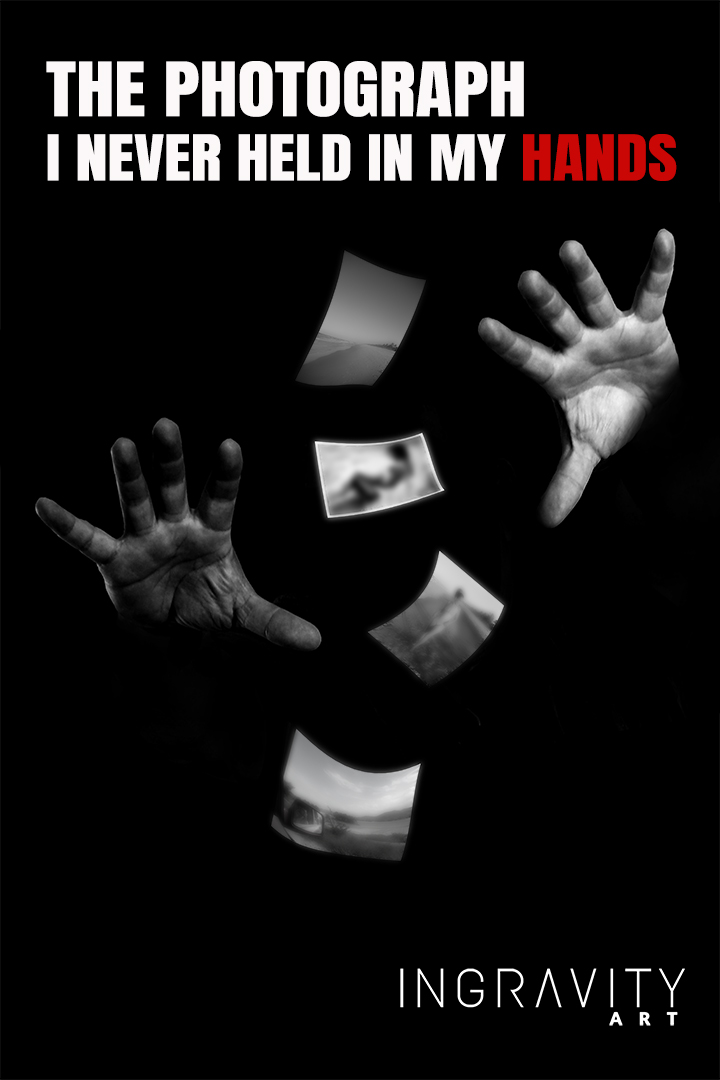
  • The Photograph I Never Held in My Hands

    The Photograph I Never Held in My Hands

    by Jorge Javier Peña Tovar

    There was a time when photographs didn’t appear immediately after you took them. You had to wait for them.

    Younger photographers grew up watching images appear on the camera’s back screen or on a phone. We grew up differently. We took a photograph and then lived with the uncertainty. We didn’t know if the focus was right. We didn’t know whether the exposure was correct. We didn’t know if that expression that seemed perfect had been caught on film or had escaped forever.

    Photography was a small act of faith.

    More than thirty years ago, my wife and I were newlyweds. We were still in that stage of life where every road looks like an invitation and every map looks like a promise. We decided to travel to Margarita Island.

    During those days, I carried with me an old Minolta that had belonged to my mother. I like to think that some cameras accumulate stories the way family albums do. They pass from hand to hand carrying memories that don’t entirely belong to them. That camera already had a life before it reached mine. What I didn’t know was that I was about to add to it a story that would stay with me for decades.

    I shoot everything. The trip, the landscapes, the small things that seem important when you’re young and in love. And La Restinga Lagoon. I remember the mangroves, the heat, the smell of the water, the sound of the boat engines crossing the lagoon. I remember the feeling of living a moment that deserved to be kept.

    I had five rolls of film. Five complete rolls, 36 exposures each. By today’s standards, that doesn’t sound like much. For those of us who grew up counting shots, it was almost a small fortune of future memories.

    When we returned, I took the rolls to the lab. Back then the story didn’t end when you pressed the shutter. There was a second stage. The wait. The developing. The excitement of opening the envelope and discovering what had come back from the trip and what had been lost along the way. We asked for the express service. Then we went for coffee, ice cream, killing time with the restless patience of someone who knows something important is happening without them.

    But Venezuela had other plans.

    While my five rolls were inside the developing machine, the power went out. One of many. A moment of darkness. A simple blackout. And without my knowing it yet, nearly two hundred photographs had just disappeared forever.

    When I returned to the lab and they handed me the envelope, I understood immediately that something had gone wrong. It was too light. Too quiet. Not the weight of five developed rolls but of a story left unfinished.

    The blackout had interrupted the process, and most of the images were gone.

    Out of five complete rolls, only four photographs survived.

    Four.

    And only two of them were from La Restinga.

    Aged Polaroid-style frame with an empty black image area, “1996” handwritten at the top, and “This photo doesn’t exist” written across the bottom.
    The photograph never made it into my hands. The memory stayed.

    The photographs that dissapear

    Everything else disappeared. The landscapes, the routes, the everyday moments. The conversations nobody photographed because they seemed too ordinary to deserve a photograph. The small scenes you assume you’ll always remember. All of it was trapped in a darkness far more permanent than the blackout.

    For a long time I thought what I had lost were some shoots. That seems logical for a photographer. But the years have a very particular way of correcting our hasty conclusions.

    With time I understood that images weren’t really what I missed.

    I missed the possibility of looking back at that trip through the eyes of the person I was then. I missed discovering details I surely forgot. A shadow. A glance. Some gesture of my wife’s that went unnoticed in that moment and that thirty years later would have meant the world.

    Because that is one of the secret functions of photographs. They don’t only preserve what we remember. They preserve what we will forget.

    And maybe that’s why losing them hurt so much. Not because they were technically important. It hurt because they were irreplaceable. The couple that appears in those images no longer exists. The newlyweds who walked through those mangroves disappeared a long time ago. The island is still there. The lagoon is still there. Even two of those photographs are still here. But the people who inhabited them belong now to another time, another body, another soul.

    Over the years, something unexpected happened.

    The photographs disappeared. But the story remained.

    I kept remembering the trip. I kept remembering the lagoon. I kept remembering the heat. I kept remembering the feeling of walking alongside the woman I had just married. The photographs were gone. The memory wasn’t. At least not entirely.

    And it was then that I understood something I had never considered.

    Maybe photographs don’t preserve memories. Maybe they preserve the doors that lead to them.

    Because memory never works alone. Memory reconstructs. It fills in empty spaces. It fills silences. It joins scattered fragments. A photograph doesn’t contain a complete story. It contains clues, fragments, small hints. And then the observer does the rest.

    The photograph provides the bricks. Memory builds the house. And sometimes it builds entire rooms using nothing but absence.

    Every now and then La Restinga would return. Sometimes as a memory. Sometimes as a question. And other times as a ghost photograph: one of those images we never saw but that, for some reason, we remain capable of imagining with a precision we haven’t earned.

    And then I understood something even stranger.

    The photographs that disappeared had an advantage the survivors could never have. They were perfect. Real photographs always have flaws. A shadow out of place. An awkward gesture. A crooked horizon. Something we could have done better. But the photographs we never got to see inhabit a different territory. They don’t exist on paper or in a file. They exist only in memory. And there the light is perfect. The composition is perfect. The youth is perfect.

    Of course none of those photographs would have actually been like that. But that no longer matters. Because they stopped belonging to photography and began to belong to the imagination.

    The only truly perfect photographs are the ones we never got to see.

    The negatives disappeared. The images are gone. The blackout won that battle. No elegant reflection, no metaphor, and no dose of nostalgia can change that fact.

    But time has a curious way of changing the questions.

    Over the years, I stopped asking myself what I had lost. I started asking what had survived.

    The story survived. The lagoon survived. The memory of the heat and the sound of the water through the mangroves survived. My mother’s old Minolta survived. Four photographs survived. And, in a way that’s difficult to explain, so did the people we were during those days. Not physically. Not exactly. But they still exist somewhere in memory, young and newly married and completely convinced that life was just beginning.

    Sometimes I think the true purpose of photographs was never to preserve the past. The past always ends up escaping. Bodies change. Cities change. People change. Maybe photographs exist to remind us that something happened. To prove to us that a moment was real. That we were once there. That we once loved. That we once were who we were.

    For years I believed the blackout had taken those photographs from me.

    Today I believe it also left me something in return.

    It left me a story. It left me a question. It left me a different way of understanding memory. And it left me the certainty that some images survive even when they disappear.

    Because thirty years later those photographs are still doing what photographs are supposed to do. They keep taking me back to Margarita, to La Restinga. I can still hear the water through the mangroves. I still find myself face to face with those two newlyweds who believed life was just beginning.

    Not bad for photographs that never got developed.

    In the end, the most valuable photograph from that trip never made it into my hands, but it lives on in my memory.

    And that, fortunately, survived the blackout.

    You can read more in Explore the Journal

    If you read Spanish, you’ll find more of these ideas at Háblame de Fotos.

  • Photographs Changed Houses

    Photographs Changed Houses

    Because memories needed somewhere to live.

    By Jorge Javier Peña Tovar.

    Today photographs live in phones, televisions, giant screens, and even in the cloud. I remember that the person who lived in the clouds was looked at sideways — “leave him alone, that one lives in the clouds.” Thinking about it now, living in the clouds wasn’t so bad. You lived in your own world, in your dreams, in your thoughts.

    As I was saying: today, photographs live in stories that disappear after twenty-four hours, and in family group chats where, inevitably, someone’s sister-in-law responds with glittery confetti, animated flowers, and a “blessed Wednesday to everyone.”

    Person browsing a digital photo library on a smartphone in front of a laptop, illustrating the shift from physical photo albums to digital archives.
    We didn’t stop making photographs. We changed where they live.

    Photographs changed houses. They didn’t disappear. They simply moved somewhere else.

    Before, they lived in enormous albums stored in drawers that closed with difficulty because inside was half a Latin American childhood compressed between plastic pages — or those they called magnetic, covered with a transparent film that over time fused itself to the surface of the photograph until there was no separating them without taking the whole image with you.

    Some appeared taped with transparent tape into school notebooks. Others slept inside shoeboxes, tucked between books, hidden and dedicated in careful handwriting — “for Jorge, with love.” And there was always a mom, a grandmother, or an aunt who knew exactly where every photograph was, even when the rest of the family seemed to be participating in an archaeological expedition every time they tried to find one.

    Then there were the slideshow nights.

    That strange ritual where someone turned off the lights, loaded a metal carousel full of memories, and turned any white wall into an improvised family cinema, which, truth be told, not everyone enjoyed.

    Click. Click. Click.

    Every sound brought birthdays, beaches, small cousins, new cars, and adults wearing pants that today should be under serious investigation by the international fashion police. One of my uncles — who was actually more of a cousin of my mother’s but we called him uncle anyway, because that’s how families work in this part of the world — had a pair. Bell-bottomed. Mustard colored. With an enormous buckle that probably had its own zip code. And he wore them with admirable dignity, like someone who has absolutely no doubt they are perfectly dressed. History would prove him right or not, but he never found out because we never told him.

    Back then, photographs didn’t appear immediately. You had to wait for them. Take the roll to the lab, endure days of uncertainty, return with the nervous excitement of someone going to pick up exam results. Then, when you finally opened the envelope and saw the images, some made you happy, others disappointed you, and a few made you seriously wonder who had taken that particular photo and why.

    But all of them had weight, physical and emotional weight. You held them in your hand and felt like you were holding something real.

    Today we take more photographs in a single weekend than my generation took in an entire childhood. We have cameras in our watches, computers, doorbells, and obviously in our phones. We photograph the food before eating it, the sky before it changes, our children every five minutes as if time were going to accelerate precisely in the moment we put the device down.

    And yet, curiously, we remember less.

    Because it turns out that abundance has a strange effect on memory. When everything gets recorded, the brain decides it doesn’t need to make the effort. Why remember if the photo is right there? Why hold onto the moment if the phone, the memory card, or the hard drive is holding it for you? So, without noticing, we end up living the experience halfway — half present, half documenting — and then we wonder why the photograph doesn’t produce the same emotion as the moment did.

    Hands holding an old family wedding album surrounded by framed photographs, reflecting how printed photographs preserve memory across generations, representing how photographs changed houses
    Some photographs don’t simply preserve a moment. They give memory a place to live.

    The answer is uncomfortable: because sometimes we weren’t entirely in the moment to begin with.

    Before, when a roll had thirty-six exposures, each one cost real money; you thought before photographing. You waited. You looked for the instant. That wait, that small ritual of attention, made the moment matter three times: once when it happened, again when you decided it deserved to be photographed, and finally when you could actually see it and relive that unrepeatable moment again and again.

    Today we photograph by reflex. And there’s something beautiful in that — the democratization of the image, the possibility that any person anywhere can document their life with a tool they carry in their pocket. But something also escaped along the way. Something resembling a pause. A deliberation. That small ceremony of looking before shooting.

    Some people are capable of staring at a photograph for entire minutes, as if trying to hear something hidden inside it. Others flip through a family album faster than a flash takes to recycle. But even so, we keep taking photographs, keep saving them, keep returning to them.

    Because deep down photographs were never just paper, screens, or digital files.

    They changed houses many times, from the album to the phone, from the projector carousel to the Instagram carousel, they moved to live in the cloud, from the drawer that never quite closed to the twelve thousand unsorted files sitting in some corner of everyone’s phone or pc waiting for a rainy day and a great deal of patience.

    But they never changed their real owner.

    Which was always us — the ones who insist on stopping time, even though time, technology, and even the sister-in-law in the family group chat have completely different plans.


    You can read more in Explore the Journal

    If you read Spanish, you’ll find more of these ideas at Háblame de Fotos.

  • Step Out of Your Frame

    Step Out of Your Frame

    The frame decides. The eye wanders.

    by Jorge Javier Peña Tovar

    Photography ends inside a rectangle. The eye doesn’t.

    I’ve always found that curious. The world isn’t rectangular. Mountains aren’t rectangular. Neither are rivers, clouds, music, or memories. And yet photography lives inside a frame.

    The strangest part is that the frame isn’t the starting point. It’s the destination.

    Because before the frame comes the lens. And the lens is round. All the immensity of the world enters through a circular window and ends up converted into a rectangle. Reality arrives free. We decide where to cut the fragment. Where does it begin? Where does it end? What stays inside? What do we leave out?

    It sounds like a technical detail. I suspect something far more important is hiding there.

    For years, we were taught to look at photography through the frame. Composition. Balance. Proportion. Rule of thirds, golden ratio, leading lines, visual weight, diagonals, and a long etcetera that sounds very convincing in a manual and, in practice, produces photographers capable of making a perfectly organized image that nobody remembers two minutes after seeing it.

    Because life happens long before it reaches that box.

    The eye is born earlier. It’s born in the instant something forces us to stop. A strange shadow on the wall. An expression that lasts half a second. The reflection in a window. A curve in the road. The sea had a blue that it didn’t have yesterday. The way someone lowers their head right after smiling.

    None of that knows the rule of thirds.

    It simply happens. And we respond.

    Maybe that’s why I’ve never been fully convinced by that way of teaching photography — as if it consisted entirely of learning how to arrange things inside a box. A box is useful for storing, yes. But a mind was made for something more than keeping tidy inventory.

    I’ve said it before: every mind is a world. Some even resemble a complete universe with maintenance problems, conflict zones, and back roads that nobody is quite sure where they lead. But a world works very differently from a box.

    In a box, things stay where they were placed.

    In a world, things find each other. They mix. They contradict each other. They cross-contaminate. They produce something new.

    That’s thinking. That’s creating.

    The most interesting ideas are rarely born in isolation. They’re born when two things that seemed unrelated suddenly discover they are. When something we learned about music collides with something we learned about photography. When a road explains composition better than a four-hundred-page manual with a glossary. When a shadow says more about a person than a complete description. When a memory meets an emotion, the two of them produce an image.

    Boxes store. Worlds connect.

    And photography always had more to do with connecting than with classifying.

    Mujer mirando a la cámara a través de un encuadre rectangular formado con sus manos desenfocadas en primer plano.
    A veces, para encontrar otra manera de mirar, primero hay que atreverse a cruzar los límites conocidos.

    We were taught to think in frames because frames are visible, measurable, and explainable. It’s much easier to teach someone to arrange elements inside a rectangle than to teach them to recognize why a scene just delivered a small punch to the chest. Rules offer security. They give the comforting sensation that if you follow them correctly, you’ll end up with a good photograph — the same way a recipe promises a reasonably decent result, provided nobody sets the kitchen on fire.

    But life doesn’t seem particularly interested in following recipes.

    The most beautiful roads are full of curves. Rivers move in serpentines. Dunes change shape every time the wind blows. Waves never repeat the same pattern. Even what we call human beauty tends to escape any serious mathematical formula, no matter how many people try with an app and a great deal of optimism.

    The world feels more comfortable with curves than with straight lines. With the unpredictable than with the perfectly resolved. With what’s alive than with what’s flawless.

    Maybe that’s why photography has always struck me as a rather beautiful geometric contradiction: we hang around our necks a machine designed to fit the chaos of the world inside an artificial order. And then we’re surprised when the chaos wins.

    I’m not suggesting we abandon technique, run out into the wilderness, and shoot as if focus were a state of mind and exposure an optional suggestion. Technique matters. It matters a great deal. It lets us materialize an idea. Control the light. Translate what we feel into something visible. Make intentional decisions instead of praying at the shutter button.

    But technique was never the destination.

    Technique is the grammar. Emotion is the language.

    You can write a flawless sentence and say absolutely nothing. You can play every note in the right place and move nobody. You can make a technically perfect photograph and have the world forget it five seconds after seeing it. Because nobody falls in love with a photograph for its precision.

    We fall in love with photographs because they remind us of something. Because they follow us. Because they hurt a little or console us without our knowing exactly why. Because they contain an atmosphere, a presence, a small truth we didn’t know how to name until it appeared in front of us as an image.

    And yet photographers have a remarkably intense relationship with the idea of domesticating everything.

    Maybe it’s an old insecurity. For decades, photography had to prove it was serious, that it had foundations, that it didn’t simply consist of pressing a button and waiting for a miracle. It needed methods, criteria, schools, technical vocabulary, and enough rules to fill an international conference with very serious people discussing very specific things for three days straight.

    I understand. In part, it was necessary.

    The problem is that we often end up confusing the tools with the purpose. We argue about sharpness as if sharpness were an emotion. We talk about composition as if composition were the final destination of an image. We chase technical perfection as if human memory had ever shown the slightest respect for technical perfection.

    It hasn’t.

    The most important photographs of our lives are rarely the most perfect ones. Sometimes they’re blurry. Sometimes they’re grainy. Sometimes they were taken with a camera that today would lose a street fight against any average smartphone. And yet they survive, not for what they resolved technically, but for what they preserved: a presence, a gesture, an era, an irretrievable version of someone who no longer exists exactly like that.

    That should remind us of something important.

    Photography wasn’t born to pass an exam. It was born to look.

    Before cameras existed, eyes existed. Before sensors existed, curiosity existed. Before rules existed, wonder existed.

    And Wonder was never particularly obedient.

    It doesn’t appear when you sit down to calculate whether the subject is placed exactly on the strong point of the frame. It appears when something shakes us enough to make us stop.

    When a shadow seems to be hiding a story. When a glance disarms us. When light enters through a window with the delicacy of someone who doesn’t want to interrupt. When a curve in the road produces that strange feeling of needing to know what comes next.

    When reality steps outside the frame.

    That’s where everything begins.

    The frame will come later. Later, we’ll decide the composition, the distance, the moment, the exposure, and the edit. Later, everything technical and necessary will arrive. But if photography forgets that earlier instant — that disordered moment when something caught our attention without asking permission — then it starts to look too much like paperwork.

    And photography was never meant to become paperwork.

    It was meant to stay an adventure.

    The problem was never learning the rules. The problem is believing the rules came first. Forgetting that a photograph can have a conversation with a song, a memory, a loss, a road, an absence, even an emotion we still don’t know how to explain. Reducing the eye to a set of formal solutions and forgetting that, at its origin, photography was a way of responding to the mystery of being alive and seeing something that, for some reason, asked to be kept.

    The frame is a decision.

    The eye is an adventure.

    And maybe the best photograph you take this year won’t be the sharpest, or the most perfect, or the best composed. Maybe it’ll be the one that made you stop. The one that forced you to look twice. The one that reminded you who you were before you learned all the rules. The one that didn’t solve a technical problem but something much harder: the need to not let pass entirely a moment that, for some reason, you felt mattered.

    Step out of your frame, because that’s where photography lives.

    Yes.

    But it enters through a round lens.

    And the freedom was always on the other side.

    You can read more in Explore the Journal

    Jorge Javier Peña is a photographer, writer, and visual storyteller based in Jacksonville, Florida. Founder of Ingravity Art and Háblame de Fotos.

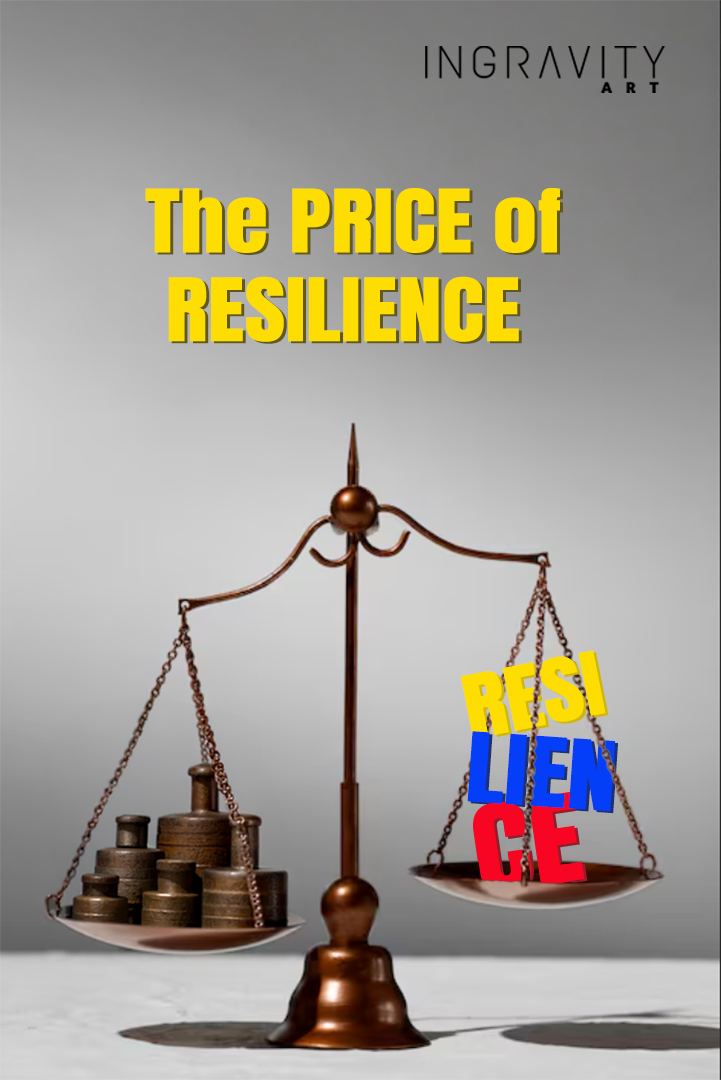
  • The Price of Resilience

    The Price of Resilience

    by Jorge Javier Peña

    Two earthquakes just hit Venezuela.

    That’s not a metaphor.

    It’s literal.

    Honestly, for those of us who have been watching our country’s story unfold from a distance for years, the difference between the literal earthquake and the one that has been shaking it for decades is sometimes hard to tell.

    And as always happens when something shakes Venezuela, the comments appeared quickly. The condolences. The messages of solidarity. And, inevitably, the word.

    Resilient.

    The Venezuelan people are so resilient.

    There are words we use as if they were always a compliment.

    Resilience is one of them.

    We hear it at conferences, in interviews, in self-help books, and even in job listings. It’s generally used to describe a person’s ability to adapt to adversity, recover after a loss, and keep moving forward despite difficulty.

    And it’s a good definition.

    The problem is that the definition seems to assume there was always a choice.

    As if life politely asked: Would you like to be resilient?

    But reality rarely works that way. Because what do you do when something terrible happens?

    Do you sit down and wait for fate to decide for you?

    Do you watch from a distance as the life you knew falls apart?

    Do you wait for someone to arrive with a box full of answers and say: “Here are the pieces of your life. Now put together what you can?”

    It doesn’t work that way.

    You pick up the pieces yourself.

    However, you can. With fear. With rage. With exhaustion.

    And you throw them over your shoulder because, simply, there is no other way to keep living.

    That’s not always resilience.

    Most of the time it’s survival. And survival is not a virtue you cultivate.

    It’s a response that activates when nothing else is left.

    Maybe that’s why I’m a little uncomfortable with how easily we admire resilience.

    Because without meaning to, we end up celebrating people’s capacity to endure things they should never have had to endure.

    A lone figure walking through a damaged urban street after a storm, illustrating The Price of Resilience for The Ingravity Art Journal.
    Sometimes resilience is not a choice. It is the only road left.

    The Price We Pay

    Resilience has a price. And it’s rarely paid by the person who admires it.

    It’s paid by the person who had to learn to live without what they took for granted.

    Without a home, a job, a routine, without a person, a country.

    Resilience is the name we give from the outside to a battle that, from the inside, almost always goes by a simpler name:

    Surviving.

    As a Venezuelan, every time I hear that “the Venezuelan people are so resilient,” I can’t help rolling my eyes.

    Not because the phrase is false. It’s true.

    What happens is that it tends to be said as if there had been another option. As if we could have chosen not to keep going. As if staying still and waiting for a miracle had been a real possibility.

    Congratulations on your resilience, Venezuela. We are deeply sorry you had to acquire it.

    Because you pick up the pieces.

    You carry them. And you keep walking. Not because you are extraordinarily strong.

    But because falling behind was never an alternative.

    Over time, you even learn to find small glimpses of happiness among the stones life throws at you. Not because you’re a hero. Not because you have some special capacity for bearing pain. But when only one road remains, walking it stops being a choice and becomes a necessity.

    And then there’s migration. Because leaving adds a second layer to that story.

    Now you have to build a new life, learn new rules, work, move forward, and make another place feel like home. But at the same time, you keep feeling the country you left behind. The streets where you grew up. The beaches where you first learned the color of the sea. The food that still tastes like childhood. The friends who stayed. The family still waiting.

    Migration has a very particular way of doubling your concerns.

    Now you fight to move forward where you are.

    And at the same time, you keep worrying about those who remained there.

    When news shakes the country where you were born, you don’t read it as news.

    You read it as if a piece of your own story were happening again.

    And you understand that you never fully leave.

    You just learn to live with your heart divided between two places.

    I can’t talk about resilience without thinking about Venezuela.

    That would be dishonest. It would mean ignoring too many stories, including my own.

    The stories of those who had to leave. The stories of those who chose to stay.

    The stories of those who have watched economic hardship, political uncertainty, literal earthquakes, and others not so literal slowly reshape the places we still call home.

    Not all wounds come from the same source.

    But they all end up asking the same thing of the person carrying them:

    Keep going. And maybe that’s why I think it’s time to admire different things.

    Not the capacity to endure. But the capacity to create.

    Not resistance to the blow. But the imagination that survives it.

    Not the strength to bear what comes. But the audacity to build something new with what remains.

    Because there is an enormous difference between a people that resists and a people that creates. Between a person who survives and a person who imagines. Between finding it admirable that someone endured so much and celebrating what they were able to build despite it.

    I hope the day comes when resilience stops being one of the highest compliments we can pay a person or a people.

    Not because resilience stops being valuable. But because that will mean fewer and fewer people are being forced to discover they had it.

    I hope the day comes when we admire more what people are capable of creating than what they were capable of surviving.

    You can read more in Explore the Journal

    Jorge Javier Peña is a photographer, writer, and visual storyteller based in Jacksonville, Florida. Founder of Ingravity Art and Háblame de Fotos.

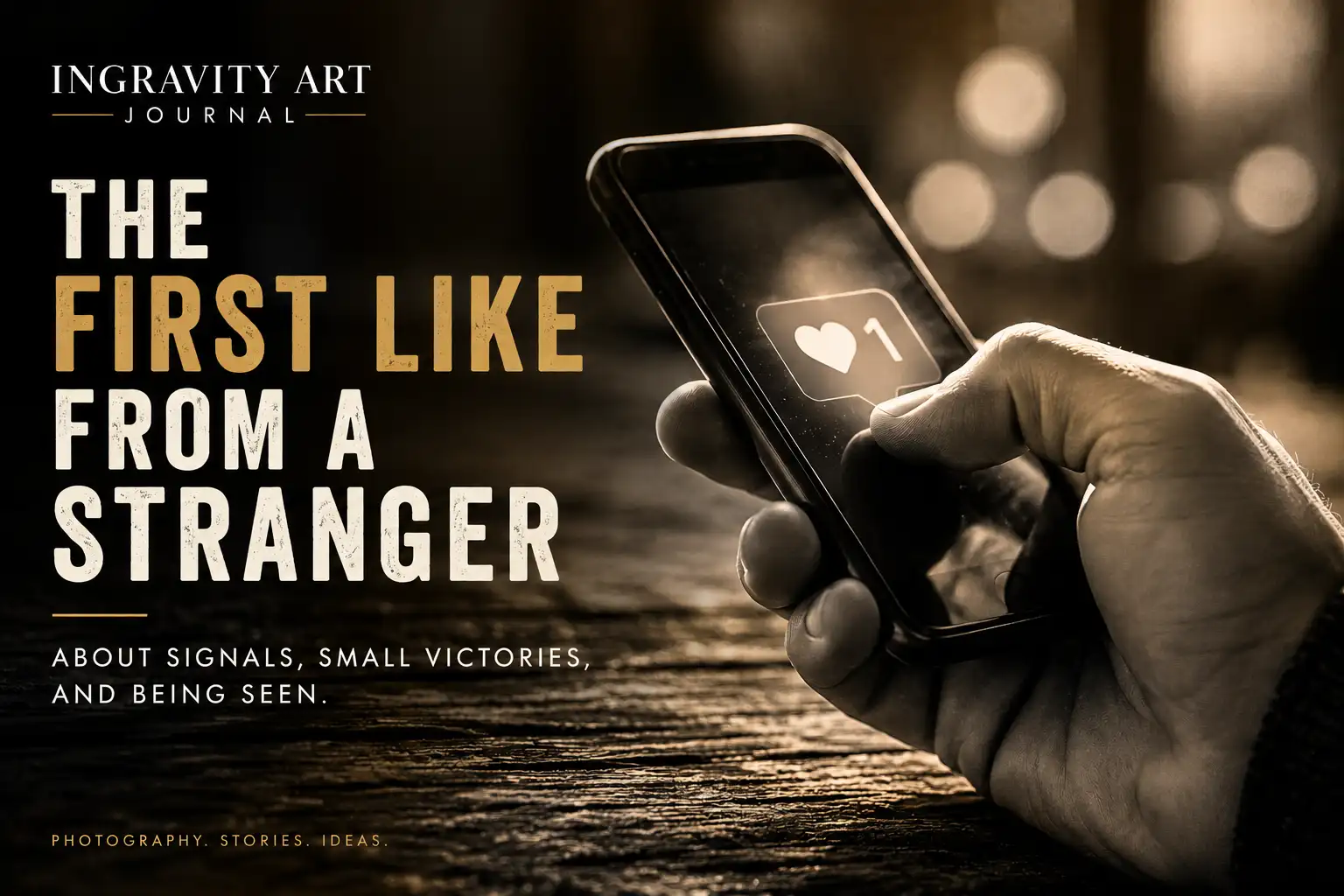
  • The First Like From a Stranger

    The First Like From a Stranger

    Stranger

    by Jorge Javier Peña

    The First Like From a Stranger

    I still remember getting my first like on Instagram. No heavenly trumpets played. Money didn’t fall from the sky. No Norwegian model appeared asking me to shoot a campaign in Santorini. It was just a tiny notification on a screen. A stranger saw something I posted and paused for a moment.

    I know. It sounds ridiculous.

    But I promise you, it wasn’t.

    Because creating things is, at its core, a way of sending signals. You post photos, write strange ideas, invent projects that would probably concern a serious psychologist, and underneath all that noise, there’s a question you don’t always dare to say out loud: is there anybody out there? Meanwhile, the algorithm stares back at you with all the enthusiasm of a bank clerk reviewing a deposit slip. No reaction. No expression. Just that face that says: next.

    Nothing happens.

    And then one day, somebody appears.

    Not your mom saying “beautiful, my love” even if the photo is crooked. Not that loyal friend who likes your blurry picture of a sandwich just because they genuinely care about you. Not even the secret admirer everybody already knows about. No. A stranger. Somebody who owes you no affection, no patience, no emotional support whatsoever. Someone with absolutely no reason to stop.

    And yet they stopped.

    They saw what you made. What you created. And not only did they see it — they liked it. That’s exactly what a like means when it comes from someone who doesn’t know you: that something of yours, born from your head, your time, your effort, made it to the other side. That the signal didn’t get lost in the void.

    Symbolic representation of receiving a first like from a stranger online.
    The signal made it to the other side.

    And yet we’ve grown so used to big numbers that we forgot how to appreciate those small arrivals. Everything gets measured in millions of views, virality, engagement, and internet gurus posing next to rented Lamborghinis while explaining how to “blow up online” in three easy steps and a nine-hundred-dollar masterclass. And the strangest part is that you end up half-believing them anyway — especially at three in the morning when your video has twelve views and eleven of them are yours.

    The problem isn’t ambition. The problem is that we were taught to measure success by a packed stadium, when most stories that actually matter began in an empty room. The Beatles rehearsing in a Liverpool basement. García Márquez writing broke in Mexico City. Your grandmother perfected her recipe for decades without anyone handing her a Michelin star. The big things almost always had a beginning that, from the outside, looked like almost nothing. A small signal sent without any guarantee of a reply.

    One person reading. One comment. One conversation. One client. One friend. A stranger stopping for a moment and giving you a like. That’s where everything actually begins.

    I remember once getting a 19 out of 20 on a high school exam. I was excited. Genuinely excited, because I was never a brilliant student — more of an average one, the kind that passes through without leaving much of a mark — but that time I felt like I had actually done something right. I showed the grade to my father, expecting maybe a compliment, a smile, a small pat on the back, anything small that confirmed he was proud.

    He looked at the paper for a few seconds and said:

    “You could’ve gotten 20.”

    And just like that, my teenage self-esteem died peacefully in the arms of the Lord.

    People never forget those kinds of phrases. Entire generations grew up feeling like joy always came with conditions attached. As if small victories didn’t quite count as victories yet. As if happiness itself came with a surcharge and a warning label: calm down, what goes up must come down. I took that warning so seriously I almost preferred not to succeed at all, just to avoid the emotional invoice that always seemed to follow.

    And that leaves a mark. Not the dramatic kind you see in movies, but something quieter and harder to trace: the habit of undermining your own work before anyone else can. Of downplaying what you’ve accomplished, not out of genuine humility, but out of a learned reflex. Because if you diminish it first, at least you control the blow. It’s an uncomfortable kind of armor, but it’s the one many of us were taught to wear.

    Maybe that’s why certain tiny signals feel so meaningful later in life.

    A message. A photograph somebody understood. A friend who read your writing and actually liked it. A song someone listened to all the way through. A stranger stopping for a few seconds in front of something that came out of your head and quietly pressing like, simply because — they liked it.

    Sometimes it doesn’t feel like approval.

    It feels like contact.

    Like those science fiction movies where someone spends years sending signals into space, not knowing if there’s anybody out there, until one day, finally, an answer arrives.

    Maybe that’s why we keep creating things. Because deep down, many artists, photographers, musicians, and writers spend their entire lives doing exactly that: sending small signals into the darkness, hoping to discover if someone exists on the other side.

    Or worse.

    Slowly discovering that maybe the alien was never out there.

    Maybe the alien was you.

    If you prefer to read Spanish, a different version of this conversation lives at Háblame de Fotos.

    Photography doesn’t end when the shutter closes. Continue the conversation in The Journal.

  • Blind Photographers

    Blind Photographers

    Part II: The Problem Was Never the Camera

    by Jorge Javier Peña

    There is something deeply ironic about modern photography.

    We have never had cameras this intelligent, this capable, this relentlessly precise. And at the very same time, it seems we are becoming less capable of actually seeing.

    Today’s cameras detect eyes, faces, animals, vehicles, birds in flight, slightly out-of-focus eyelashes, and eyelashes that are simply too ambitious for their own good. At the current rate, they will probably soon detect existential crises and automatically remove former romantic mistakes from every photograph in your archive.

    Everything seems to be moving toward the complete automation of the photographic act.

    And yet there is one thing that remains stubbornly resistant to automation: human sensitivity.

    A camera can recognize an eye without understanding nostalgia. It can measure light without recognizing tenderness. It can calculate a perfect exposure while remaining completely unaware that someone standing in front of the lens is seconds away from falling apart emotionally.

    And there lies one of the great modern tragedies of photography. Many of us learned to operate extraordinary cameras. But somewhere along the way, we forgot to develop our way of seeing. Or worse: nobody ever told us those were two different skills.


    The Photographer Who Learned to See Without Looking

    Blind photographers represented by men wearing a red blindfold smiling against a dark background, illustrating visual perception, photography, and the difference between seeing and looking.
    A camera can recognize an eye without understanding nostalgia.

    For years, photographic education slowly drifted toward a kind of technological obsession where artistic growth seemed to depend almost entirely on more megapixels, greater dynamic range, sharper lenses, faster autofocus, higher resolution, deeper shadow recovery, more laboratory charts, more comparison videos, more firmware updates, and more people spending forty minutes discussing ISO performance only to end up photographing the same cat as everyone else.

    And once again: technology is not the enemy. Technique is not the enemy either. The problem begins when we start confusing tools with purpose.

    Because many photographers eventually fall into a very peculiar trap. They begin looking at the world exclusively through technical specifications. And then something terrible happens. Something quiet. Something almost invisible.

    They stop reacting emotionally to what is in front of them. They stop noticing presence. They stop contemplating humanity. They stop feeling atmosphere. At some point, they stop looking altogether and begin performing technical inspections of reality.

    “The shadows are blocked.”
    “The dynamic range isn’t enough.”
    “The focus didn’t land precisely on the eye.”
    “The sharpness isn’t perfect.”

    Meanwhile, life continues its stubborn habit of happening right in front of them. Unfortunately, life has never shown much respect for autofocus settings.


    The Ones Who Photograph Without Seeing

    That is probably why I keep thinking about blind photographers.

    Yes, they exist. And not only do they exist. They photograph. They compose. They interpret. They create images that work.

    Evgen Bavčar is a Slovenian photographer who lost his sight at eleven years old. He has spent decades producing images exhibited in museums across Europe and beyond. When asked how he photographs without seeing, his answer should make any technically obsessed photographer genuinely uncomfortable: he says he photographs from memory, from desire, from what he imagines exists in front of him.

    From what he feels. Not from what he sees.

    Which forces an uncomfortable question that nobody in photography’s internet forums wants to ask: if someone can build powerful images without physical vision, what exactly is the excuse of someone who sees perfectly but feels nothing standing in front of a camera?

    Because blind photographers force us to reconsider something essential. Perhaps seeing was never simply about receiving visual information. Perhaps it also involves perceiving presence, tension, emotion, intuition, memory, and humanity. Everything a sensor cannot measure and no autofocus system can detect.


    Cartier-Bresson in the Dock

    That is where we inevitably return to Henri Cartier-Bresson.

    If someone wanted to dismantle half of contemporary photography’s obsession with technical perfection, all they would need to do is place a group of modern photographers in front of some of his images and quietly wait.

    Someone would say: “It’s a little blurry.”
    Another: “There isn’t enough sharpness.”
    And someone particularly possessed by YouTube would eventually declare: “With a modern camera, this would look much better.”

    Meanwhile the photograph remains alive. Decades later. Untouched.

    Because Cartier-Bresson understood something fundamental that we still forget while debating sensors and specifications: the moment does not wait for perfect sharpness. The moment does not wait for firmware updates. The moment occurs. And the photographer decides whether they are awake enough to recognize it before it disappears.

    That difference still separates making photographs from merely operating cameras. A camera records visual information perfectly. Only a human being can recognize meaning inside it.


    What No Sensor Will Ever Resolve

    That is precisely why photography remains important in a time when nearly every phone can produce technically impressive images. The real difference was never inside the camera. It was always inside the person holding it.

    More precisely: inside the ability to stop. To contemplate. To spend time looking at an idea, a shadow, a face, or even admiring the apparent immortality of a crab.

    (Evidence regarding the apparent immortality of crabs remains inconclusive.)

    Because we live in a culture overflowing with people occupying their gaze but very few truly inhabiting it.

    And perhaps that is the real danger. Not that cameras become too intelligent. But that we stop observing deeply precisely because cameras have become too intelligent.

    Miguel barely has eyes and still looks back at us.

    Bavčar sees nothing and has spent decades building images the rest of us never learned to see.

    Cartier-Bresson used imperfect cameras and produced photographs that survive almost everything.

    The question is no longer what camera you need.

    The question is whether you still know how to look.

    Did you read Part One yet?

    If you read Spanish, a different version of this conversation lives at Háblame de Fotos.

    Photography doesn’t end when the shutter closes. Continue the conversation in The Journal.

    Jorge Javier Peña is a fine art and boudoir photographer based in Jacksonville, Florida. He is the founder of Ingravity Art, where he explores portraiture, identity, and the human presence in front of the camera.

  • The Gaze Doesn’t Live Only in the Eyes

    The Gaze Doesn’t Live Only in the Eyes

    By Jorge Javier Peña

    Part I: Miguel and the Problem of Seeing

    Photography has spent decades obsessed with eyes.

    Focus on the nearest eye. The eyes are the window to the soul. Catchlights matter. Sharp eyes sell portraits. Eye detection autofocus. Eye tracking. Eye everything.

    At times, it feels as if the internet has collectively decided that a photograph without perfectly illuminated eyes is a form of visual misconduct.

    And yes, of course, eyes matter. Nobody is arguing otherwise.

    Eyes can carry an entire photograph. They can pierce through the frame. They can tell stories without a single word.

    The problem begins when a useful observation becomes a universal law. Modern photography has a strange tendency to turn good advice into sacred commandments.


    Miguel and the Limits of Technical Perfection

    Portrait of Miguel, a blind farmer whose image challenges traditional ideas about photography perception.
    Miguel, a blind farmer from the Andes, reminds us that seeing and understanding are not always the same thing.

    Then Miguel entered the conversation.

    Miguel is a blind farmer from the Andes. And when I say blind, I don’t mean the poetic Instagram version of blindness. I mean someone whose eyes are no longer truly functional.

    And yet the photograph still works. It still communicates. It still carries emotional weight.

    Which is rather inconvenient for an industry increasingly obsessed with eye autofocus, face detection, pupil tracking, and other features that sometimes sound less like photography and more like military-grade surveillance software.

    Because Miguel barely has eyes. And yet he still looks back at us.

    That was the moment something clicked for me.

    Perhaps the gaze doesn’t live only in the eyes. Sometimes it lives in presence. In gesture. In dignity. In the emotional weight carried by a face. In the stories accumulated across a lifetime of skin. In silence. In the way someone exists in front of a camera.

    Because deeply human photographs rarely depend on a single element. And this is where photography perception becomes something far more interesting than a technical discussion: emotion does not enter an image exclusively through the retina. Sometimes it enters through intuition. Through memory. Through everything we imagine while looking.


    When Photographers Stop Seeing People

    And there lies one of modern photography’s biggest problems: we have become so busy seeing parameters that we often stop seeing people.

    Dynamic range. Extreme sharpness. Microcontrast. Color science. Shadow recovery. Skin texture. Sensors. Resolution.

    At times, photographic discussions sound less like conversations between people trying to understand the world and more like engineers inspecting a nuclear power plant.

    Now, technique matters. Of course, it matters. Technique is language. Technique is structure. Technique is a tool.

    But a tool should never replace the gaze itself.

    Learning photography is remarkably similar to learning how to write. The words are available to everyone. Grammar is available to everyone. Yet that alone does not make someone a writer. Because what truly matters is not simply knowing how to use words. It has something worth saying. And perhaps even more importantly, knowing how to say it.

    Photography works the same way.

    Learning exposure, composition, lighting, and technical control matters. Of course, it does. But technique alone guarantees neither emotion nor humanity. It does not guarantee presence. A camera can record a scene perfectly and still have absolutely nothing to say.

    That is why I keep thinking about Miguel. Because Miguel destroys many modern photographic recipes simply by standing in front of a camera.

    Meanwhile, we continue repeating the same familiar phrases: the eyes are everything, the gaze is everything, without a gaze there is no photograph.

    Then we are forced to confront an uncomfortable truth: technically perfect images can feel empty. And there are imperfect photographs that remain alive decades later.


    Cartier-Bresson and the Human Moment

    This is where Henri Cartier-Bresson becomes a small philosophical earthquake shaking contemporary technical obsession.

    If many of his photographs were judged by the standards of today’s internet photography groups, people would find flaws everywhere. Motion blur. Grain. Lack of extreme sharpness. Photographs that fall far short of the sterile perfection we often celebrate today.

    And yet they survive. They teach. They endure. They breathe.

    Why?

    Because Cartier-Bresson understood something we still forget while debating sensors and specifications on YouTube: photography happens in the human moment. Not in absolute perfection. Not in the perfect pixel. Not in the miracle lens.

    It happens in perception. In the ability to recognize when something invisible has just happened in front of us.

    The camera records light. The photographer records meaning. Unfortunately, many of us skipped that class.

    That is why technique should accompany the gaze. Never replace it. Because seeing a scene perfectly is one thing, understanding it is something entirely different.


    The Question Nobody Wants to Ask

    And eventually, we arrive at the question nobody wants to ask while comparing sensors, sharpness charts, and laboratory measurements:

    What happens when photographers begin trusting what the camera says more than what they feel standing in front of it?

    Because perhaps Miguel was never the problem.

    Perhaps the problem is us.

    Perhaps photographers can go blind too. Not in the physical sense, but in the way that truly matters for photography perception: losing the ability to feel what stands in front of the lens, to recognize meaning before reaching for settings.

    And if that is true, then perhaps we should ask something even more uncomfortable:

    How many photographs have we failed to see while believing we were seeing them perfectly?

    Part II: Blind Photographers
    (To be continued…)

    Jorge Javier Peña is a fine art and boudoir photographer based in Jacksonville, Florida. He is the founder of Ingravity Art, where he explores portraiture, identity, and the human presence in front of the camera.

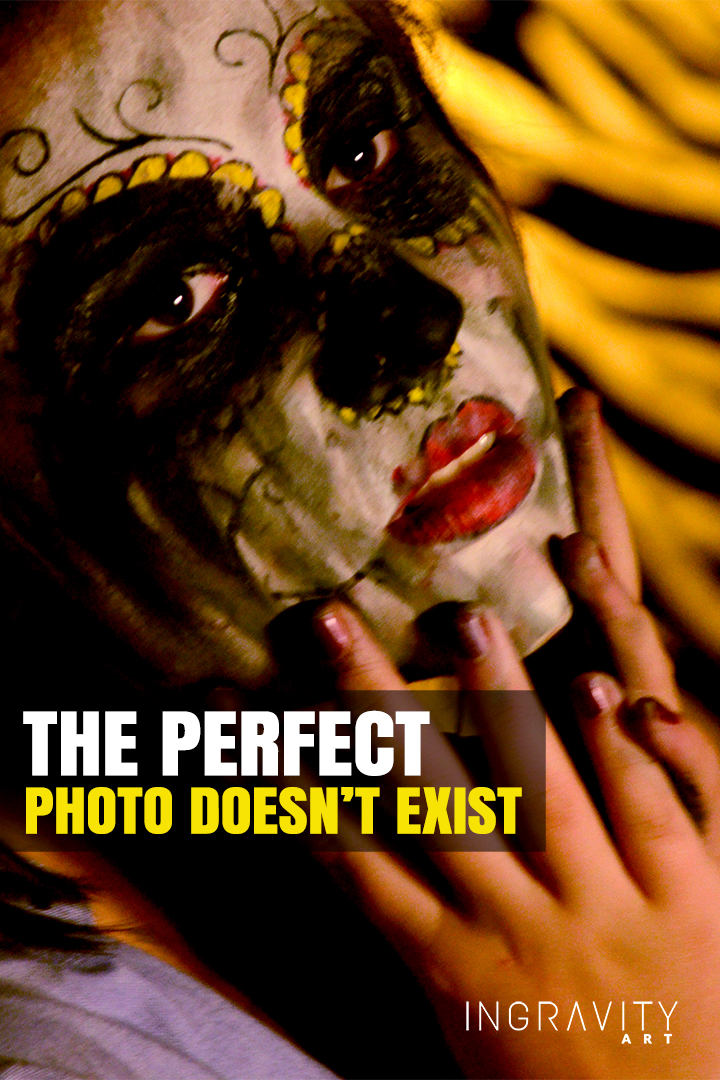
  • The Perfect Photograph Does Not Exist

    The Perfect Photograph Does Not Exist

    Or how photography became an international competition of zooming to 400%

    By Jorge Javier Peña

    The perfect photograph might be the greatest illusion modern photography ever created.

    There’s a scene that happens on the internet every single day with the precision of a Swiss watch and the spiritual joy of a tax audit.

    Someone posts a photograph. The image has something. Not necessarily perfection. Something worse: life. Maybe it’s blurry. Maybe it has grain. Maybe the exposure decided to leave the party without asking permission. But the photograph breathes. You stop. You look at it two seconds longer than usual. You feel something.

    And then he appears.

    The Forensic Critic.

    “Nice attempt, but the focus is slightly off on the left eye.”

    Life is full of people capable of ignoring a devastating photograph because they discovered microscopic digital noise in a shadow after zooming in as if they were searching for bacteria during a visual autopsy. The image could be talking about grief, memory, desire, fear, or the last time someone hugged their father before he died. But the conversation has already moved somewhere else. Now we’re all trapped inside an unsolicited seminar about peripheral sharpness and dynamic range.


    The Myth of the Perfect Photograph

    Welcome to the strange historical moment where some people love histograms more than photographs.

    Somewhere along the way, the idea of the perfect photograph became more important than the emotional experience behind it. And honestly, it’s not entirely their fault. Photography was born with an existential crisis already built into it. From the very beginning, nobody could fully decide whether it was art, science, document, evidence, or simply an elegant way to make painters nervous.

    Nineteenth-century pictorialists tried to make photography look like painting because the art world of the time needed cultural permission to take it seriously. Later came technical giants like Ansel Adams, developing control systems so precise they looked like aerospace engineering applied to mountains. Adams spent years perfecting the Zone System, a method for controlling tonal values with almost mathematical exactness. He could predict, before releasing the shutter, exactly how each shadow and highlight would behave in the final print.

    But here’s the detail that gets lost in every YouTube review about his legacy: Ansel Adams did not master technique because he worshipped numbers. He mastered it because he needed to translate exactly what he felt standing in front of a landscape. The technique was language. A very precise, very demanding language. But language in service of something larger than itself.

    Not religion. Not destination. Language.

    Somewhere along the way, that got lost. And photography slowly began filling up with people more interested in evaluating images than actually looking at them.

    Schools carry part of the responsibility. Not because they teach technique. Technique matters; it’s essential. The problem begins when technique becomes the spiritual center of the photographic experience, the thing the entire conversation orbits around.

    Because teaching sensitivity is extraordinarily difficult. How do you evaluate presence? How do you grade intuition? How do you explain that strange instant when someone drops their guard in front of a camera for half a second, and suddenly a photograph appears that feels more discovered than taken?

    That doesn’t fit easily into an academic rubric.

    The rule of thirds does.

    So we end up producing entire generations of technically flawless photographers capable of creating perfectly exposed images that generate the same emotional response as the instruction manual of a double-door Samsung refrigerator.

    Extremely correct photographs.

    Dead, but extremely correct.

    Imperfect family photographs showing emotional memory, blurred laughter, damaged printed photos, and authentic human connection beyond technical perfection.
    Some images survive not because they were the perfect photograph, but because something real happened inside them.

    Jazz, Imperfection, and the Photographers Who Understood

    This is not a romantic defense of visual disaster. It is not an invitation to shoot blindly while screaming “art.” Authentic spontaneity is not technical ignorance. It’s technical freedom.

    It’s jazz.

    A musician who knows no music theory is not improvising. He’s lost. But someone who understands structure so deeply that they no longer need to think about it can finally let go and actually listen to what’s happening in the room, in the moment, between the notes.

    Great photography works exactly the same way.

    Henri Cartier-Bresson did not stop to mourn because a shadow contained grain. He was too busy recognizing the precise instant when geometry, light, and human movement aligned into something that would never happen again.

    Robert Frank practically redefined modern photography with The Americans, a book that, when it was published in 1958, was received by part of the critical establishment with open hostility. The images were considered too dark, too raw, too unpolished. Frank photographed America as he actually saw it, not as it preferred to be seen. Crooked. Tired. Contradictory. Beautiful in ways that made people uncomfortable. Today, those same images are considered among the most important photographs of the twentieth century. The critics who dismissed them are footnotes. The work remains.

    Daido Moriyama built an entire aesthetic from high contrast, extreme grain, radical blur, and images that many academic photography professors would fail before finishing their first breath. His work looks, by conventional technical standards, almost deliberately broken. And yet it communicates something about Tokyo, about urban life, about the body moving through a city, that no technically pristine image has ever managed to capture with the same visceral intensity.

    The most dangerous photographers are not the ones who ignore the rules.

    They are the ones who stopped living in terror of them.


    What Imperfection Can Say That Perfection Cannot

    There are things only imperfection can say.

    A slightly blurred photograph can communicate anxiety better than a perfectly frozen one. Brutal overexposure can transform a body into pure memory. An “incorrect” backlight can make someone appear to dissolve into their own life, to exist at the edge of disappearing.

    Technical perfection records.

    The right imperfection interprets.

    And that changes everything about what a photograph can do.


    The Venezuelan Living Room Problem

    I also believe that those of us who grew up in Venezuela, and probably across much of Latin America, understand this particular pressure in a very specific way.

    There’s something deeply ours about the obsession with looking right. The ironed clothes before leaving the house. The living room perfectly arranged the moment visitors are expected, even while the rest of the house looks like the emotional survivor of a civil war. The endless “what will people think?” The permanent social performance. The exhausting, lifelong pursuit of the perfect appearance.

    That same pressure exists in photography.

    The image has to look correct before it is allowed to feel true. And during that process of correction, we often kill the exact thing that made the photograph alive in the first place.

    Spontaneity rarely survives the obsession with pleasing everyone.


    The Woman in Front of the Camera

    This becomes even more obvious when photographing people.

    A woman standing in front of your camera does not need a histogram scientist. She doesn’t need someone calculating depth of field while nodding intellectually like a recently ordained priest of Saint Adobe Lightroom Church. She needs human presence. She needs to feel that somebody is actually seeing her, not measuring her.

    The best photographs of people rarely happen when everything is perfectly controlled. They happen when something real crosses the scene in the half second before the person puts the mask back on. When the performance slips. When the guard drops. When something true surfaces briefly and then disappears.

    That lasts seconds. Sometimes less.

    No plugin recovers an emotion you were never present enough to notice.


    What Remains

    That’s why the photographs that survive in memory are rarely the most technically perfect ones. They’re usually the ones containing something slightly broken. Something strange. Something that shouldn’t work and yet works precisely because of that. Images that continue existing emotionally long after the moment itself has disappeared.

    Like people.

    Because human beings are not perfectly exposed either.

    We all have blown highlights, digital noise, motion blur, parts of ourselves we try to hide, moments out of focus, shaken emotions, overexposed memories, and fragments of life that no post-production can fully correct.

    Maybe that’s why photographs that are too perfect sometimes feel so difficult to truly look at. So technically impressive and so emotionally distant.

    Because life does not happen perfectly aligned.

    Life happens fast.
    Crooked, sometimes blurry, sometimes improvised.
    Sometimes beautiful precisely because there wasn’t enough time to control it.

    That’s why some images survive for decades while others disappear the moment the scrolling ends.

    Not because they were perfect.

    But because they were alive.

    And in the end, nobody remembers the histogram, the dynamic range, ISO 50,000, or the 400% zoom.

    People remember how an image made them feel.

    And that, fortunately, still cannot be measured by Adobe Lightroom.

    Jorge Javier Peña is a fine art and boudoir photographer based in Jacksonville, Florida. He is the founder of Ingravity Art, where he explores portraiture, identity, and the human presence in front of the camera.

  • Visual Criterion: Why Two Photographers Using the Same Recipe Create Different Images

    Visual Criterion: Why Two Photographers Using the Same Recipe Create Different Images


    Visual Criterion

    What Photography Tutorials Rarely Teach

    Visual criterion is not something we learn easily.

    For years, photography has been taught as a giant cookbook disguised as technical education. Put the light here. Use this lens. Shoot at f/2.8. Turn the face forty-five degrees. Separate the subject from the background. Enable this, disable that.

    The silent promise always seems to be the same: follow these steps, and you will eventually arrive at the correct result.

    And to be fair, recipes work. Of course, they do. If they didn’t, workshops would disappear, tutorials would vanish, and half of YouTube would collapse under the weight of cinematic-photo-in-five-minutes thumbnails featuring shocked faces and titles written entirely in capital letters.

    The problem is that anyone who has spent enough time in a kitchen already knows an uncomfortable truth: two people can use the same ingredients and still cook completely different things.


    The Recipe Nobody Wrote Down

    Most families know this mystery by heart.

    Grandma left the recipe behind. Two cups of flour, one spoon of this, a pinch of that, fifteen minutes in the oven. Everyone follows the instructions with near religious devotion. And eventually, someone says the inevitable sentence:

    “It’s good… but it doesn’t taste the same.”

    Nobody explains it properly. The explanation always drifts into strange territory. It was her hands. The way she stirred. Her timing. The fact that she somehow knew when to turn off the stove without checking the clock. Maybe she tasted the sauce first. Maybe there was some invisible ingredient nobody ever wrote down.

    Seasoning.

    Photography feels exactly the same way.

    Two photographers can stand in the same place using the same camera, the same lens, the same light, photographing the same person. They can literally stand shoulder to shoulder and still create entirely different images. Not small differences. Completely different photographs.

    Not because one photographer discovered a secret setting buried deep inside a camera menu designed by mysterious Japanese engineers.

    The difference lives somewhere much harder to explain: the visual criterion.


    Portrait of a young woman seated on an ornate chair with a French bulldog demonstrating how photographers create unique visual styles
    The throne creates authority. The bulldog creates tenderness. The tension between them creates the portrait

    What Nobody Stops to Teach

    The problem is that the visual criterion is rarely taught.

    We learn exposure, composition, shutter speed, aperture, lenses, rules, and settings. We learn tools. But very few people stop to explain how someone actually learns to see.

    Because seeing is not simply opening your eyes.

    Seeing is choosing.

    Choosing what stays and what disappears. What deserves to remain inside the frame and what can quietly leave. What deserves patience and what deserves to be ignored. What is worth waiting for and what was never going to happen regardless of how long you stood there.

    Something strange happened to me after years of making photographs. I stopped consciously calculating many of the things I once analyzed obsessively. I no longer think through every tiny detail before pressing the shutter. Sometimes I simply feel that the image is not ready yet.

    So I move two steps forward. Step back one. Wait for a cloud. Wait for a glance. Wait for the wind. Wait for somebody to lower a hand at exactly the right moment. Wait for chaos to do something unexpected.

    Because chaos always does.

    That probably explains the plaque sitting on my desk that reads: Chaos Coordinator.

    After enough years with a camera, you realize you are not always searching for an image. Sometimes you are waiting for permission. Permission from light. From timing. From the particular chaos that turns an ordinary scene into something worth keeping.

    Photography often feels like a three-ring circus where everything appears random and completely out of control. And yet someone moved the lights, chose the location, watched the trapeze artist carefully, and somehow knew the exact moment to press the button. Not because they calculated it. Because they recognized it.

    That recognition is visual criterion.


    From Instructions to Intuition

    Eventually these decisions stop feeling like instructions and become something else entirely.

    They become intuition. Something like driving after many years behind the wheel, or preparing a barbecue without checking the clock every three minutes. You stop following steps and start reading signals. You stop asking what the rules say and start trusting what your eye already knows.

    And eventually you understand something that once sounded completely absurd: recipes matter, of course they matter, but nobody remembers the recipe.

    People remember the seasoning.


    The Uncomfortable Role of Failure

    There is something else tutorials almost never mention. Something that probably has more to do with developing visual criterion than any camera setting ever will.

    Making mistakes.

    Modern culture has developed a strange obsession with getting everything right on the first attempt. We want the perfect photograph, the perfect idea, the perfect sentence, and the perfect decision, preferably without suffering the deeply uncomfortable experience of failing in front of other human beings.

    Bad news: life never received that memo.

    Most of what we know was learned while improvising. Nobody was born knowing how to drive, how to love, how to raise children, how to cook, or how to understand why a photograph that looked incredible inside our heads somehow ended up looking like evidence from a police report taken at three in the morning.

    I have repeated a line for years, usually as a joke:

    “I never make mistakes. Well… I made one once. When I thought I was wrong.”

    More or less a joke.

    But humor has a dangerous habit. Sometimes it arrives disguised and quietly delivers uncomfortable truths on its way out. Because people who never make mistakes often belong to a very specific category: people who never actually do anything.

    Developing your own eye, your own voice, your own visual criterion demands exactly the opposite. You have to try. Fail. Move the camera. Step back. Repeat. Insist. Accept that some photographs, some ideas, and some decisions simply will not become what you imagined, and that this is not failure. It is how the eye learns to see.

    Grandma’s recipe probably did not appear perfect on day one either. There were experiments. Accidents. Smoke. And probably at least one soup somebody politely pretended to enjoy.


    What Cooks Slowly

    Technique can be learned in a workshop, a course, a tutorial, or an afternoon watching YouTube with enough patience and coffee.

    Visual criterion is different.

    It does not arrive on schedule. It does not respond to shortcuts. It cannot be downloaded, preset, or purchased alongside a new camera body.

    It cooks slowly.

    And it tastes considerably better with seasoning.

    Photography doesn’t end when the shutter closes. Continue the conversation in The Journal.

    If you read Spanish, you’ll find more of these ideas at Háblame de Fotos.

    Jorge Javier Peña is a fine art and boudoir photographer based in Jacksonville, Florida. He is the founder of Ingravity Art, where he explores portraiture, identity, and the human presence in front of the camera.

  • Selfie vs. Self-Portrait: Same Face, 2 Completely Different Universes

    Selfie vs. Self-Portrait: Same Face, 2 Completely Different Universes

    A reflection on identity, photography, and the strange ways we have learned to look at ourselves

    by Jorge Javier Peña

    Long before front cameras, ring lights, and the quiet tyranny of social media feeds, artists were already pointing lenses and brushes at themselves, creating self portraits, trying to answer a surprisingly difficult question:

    Who exactly am I?

    Rembrandt painted himself more than ninety times throughout his life. Not necessarily because he was in love with his own face, although every artist probably has a complicated relationship with mirrors. He used himself as material. As a place to think. As a way of understanding what it meant to be human at different ages, in different lights, under different emotional weights. His use of shadow and directed light became so influential that centuries later, photographers would borrow his name for an entire lighting technique still taught in portrait studios today.

    Frida Kahlo pushed that idea even further. Her self portraits never felt like beauty campaigns. They felt like visual diary entries written by someone who refused to edit her own reality. Pain, identity, resistance, memory. She painted what existed, not what people expected to see.

    That difference matters.

    Because self portraits were never really about appearance. They were about presence.

    Then the Selfie Arrived

    In 2013, Oxford Dictionaries chose selfie as its Word of the Year, officially acknowledging what was already becoming a defining cultural behavior. Somewhere between that moment and now, humanity collectively decided that photographing ourselves twenty times a day was completely normal.

    Maybe it is. Maybe it isn’t. But that is exactly where the conversation gets interesting.

    Because, despite sharing a face and a camera, a selfie and a self portrait are not remotely the same thing. And the difference has very little to do with technology and almost everything to do with intention.

    A selfie says: Here I am. Look at me.

    A self portrait says: Here I am. Think about me.

    There is nothing wrong with either one. A selfie can simply be proof of existence. I was here. Wearing this. Eating this. Emotionally surviving this particular Monday. Perfectly valid.

    The problem starts when we confuse presence with depth.

    Because self portraits ask for something far more uncomfortable. They ask us not just to show ourselves but to explore ourselves. And exploration has always been expensive. Not financially. Emotionally.

    The Abundance That Made Us More Uncomfortable

    There is something genuinely strange happening in modern life.

    Never in human history have we taken this many photographs of ourselves. And somehow, never have so many people felt so profoundly uncomfortable with their own image.

    That feels almost absurd when you sit with it long enough.

    We have learned angles, lighting tricks, editing habits, poses, filters, and tiny visual survival strategies refined through hundreds of attempts and deletions. We have learned which versions of ourselves feel safe enough for public consumption. And somewhere in that process, something quietly shifts.

    You stop looking for yourself and start looking for a version of yourself capable of surviving other people’s attention.

    That is why someone takes twenty photographs and deletes nineteen. Sometimes all twenty. Not because they are shallow or vain. But because being looked at has always been slightly terrifying. And being looked at by everyone simultaneously, which is what posting an image online actually means, is something human beings have never had to navigate before in quite this way.

    Especially in cultures like ours, where family members can discuss somebody’s appearance with the analytical seriousness of economists reviewing quarterly projections. Any Latino reading this just smiled because you already know exactly which aunt just walked into the room.

    So no, this was never just about cameras. It was always about the gaze. About what happens inside us when we feel seen.

    Self Portrait vs Selfie mirror self portrait exploring identity and visual culture
    Sometimes the camera points outward. Sometimes it quietly turns back toward us

    What Rembrandt Understood That the Algorithm Does Not

    The self-portrait has always been less about recording a face and more about confronting one.

    Rembrandt, at twenty-three, painted himself with the confidence of someone who had not yet been broken by anything. Rembrandt, at sixty-three, painted himself with the honesty of someone who had been broken by almost everything and was still standing in front of the canvas. The face changed. What he was looking for in the face changed more.

    That continuity across a lifetime is what separates a body of self-portraits from a collection of selfies. Not quality. Not technology. Not even intention in the immediate sense. It is the willingness to keep looking at yourself honestly over time, even when what you find is uncomfortable.

    Kahlo understood this too. She did not paint herself to be admired. She painted herself to be understood. There is a significant distance between those two desires, and most of what we post online lives firmly on the admiration side of that distance.

    What Remains

    Maybe that is why some self-portraits survive centuries while yesterday’s selfies disappear before the next coffee gets cold.

    A self-portrait carries something beyond appearance. Not perfect lighting or ideal angles. Something heavier. Something human. It says: This is who I was. Not this is how I looked.

    And that changes everything about what an image can do.

    Selfies can show a face. Self-portraits reveal a life.

    The difference between the two never lived inside the camera. It was always hiding somewhere in the courage required to truly look back at yourself.

    If you read Spanish, you’ll find more of these ideas at Háblame de Fotos.

    Photography doesn’t end when the shutter closes. Continue the conversation in The Journal.


    Ingravity Art explores photography, identity, and visual culture through stories and experiences designed to reveal presence, humanity, and the emotional life behind the image.