
by Jorge Javier Peña
Two earthquakes just hit Venezuela.
That’s not a metaphor.
It’s literal.
Honestly, for those of us who have been watching our country’s story unfold from a distance for years, the difference between the literal earthquake and the one that has been shaking it for decades is sometimes hard to tell.
And as always happens when something shakes Venezuela, the comments appeared quickly. The condolences. The messages of solidarity. And, inevitably, the word.
Resilient.
The Venezuelan people are so resilient.
There are words we use as if they were always a compliment.
Resilience is one of them.
We hear it at conferences, in interviews, in self-help books, and even in job listings. It’s generally used to describe a person’s ability to adapt to adversity, recover after a loss, and keep moving forward despite difficulty.
And it’s a good definition.
The problem is that the definition seems to assume there was always a choice.
As if life politely asked: Would you like to be resilient?
But reality rarely works that way. Because what do you do when something terrible happens?
Do you sit down and wait for fate to decide for you?
Do you watch from a distance as the life you knew falls apart?
Do you wait for someone to arrive with a box full of answers and say: “Here are the pieces of your life. Now put together what you can?”
It doesn’t work that way.
You pick up the pieces yourself.
However, you can. With fear. With rage. With exhaustion.
And you throw them over your shoulder because, simply, there is no other way to keep living.
That’s not always resilience.
Most of the time it’s survival. And survival is not a virtue you cultivate.
It’s a response that activates when nothing else is left.
Maybe that’s why I’m a little uncomfortable with how easily we admire resilience.
Because without meaning to, we end up celebrating people’s capacity to endure things they should never have had to endure.

The Price We Pay
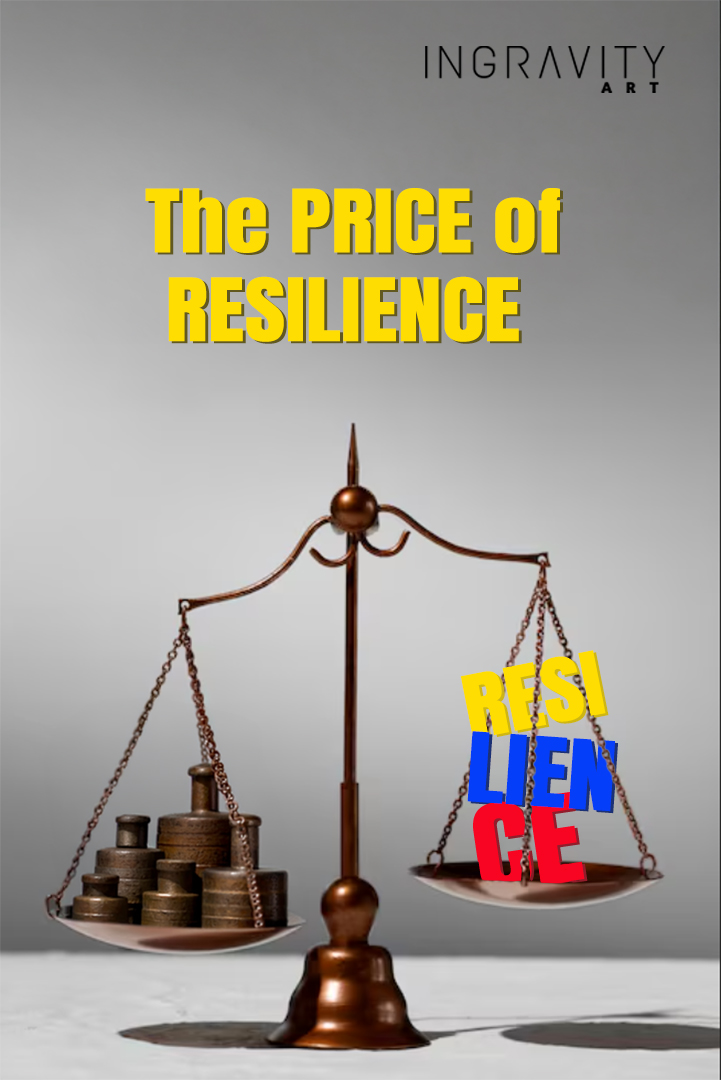
Resilience has a price. And it’s rarely paid by the person who admires it.
It’s paid by the person who had to learn to live without what they took for granted.
Without a home, a job, a routine, without a person, a country.
Resilience is the name we give from the outside to a battle that, from the inside, almost always goes by a simpler name:
Surviving.
As a Venezuelan, every time I hear that “the Venezuelan people are so resilient,” I can’t help rolling my eyes.
Not because the phrase is false. It’s true.
What happens is that it tends to be said as if there had been another option. As if we could have chosen not to keep going. As if staying still and waiting for a miracle had been a real possibility.
Congratulations on your resilience, Venezuela. We are deeply sorry you had to acquire it.
Because you pick up the pieces.
You carry them. And you keep walking. Not because you are extraordinarily strong.
But because falling behind was never an alternative.
Over time, you even learn to find small glimpses of happiness among the stones life throws at you. Not because you’re a hero. Not because you have some special capacity for bearing pain. But when only one road remains, walking it stops being a choice and becomes a necessity.
And then there’s migration. Because leaving adds a second layer to that story.
Now you have to build a new life, learn new rules, work, move forward, and make another place feel like home. But at the same time, you keep feeling the country you left behind. The streets where you grew up. The beaches where you first learned the color of the sea. The food that still tastes like childhood. The friends who stayed. The family still waiting.
Migration has a very particular way of doubling your concerns.
Now you fight to move forward where you are.
And at the same time, you keep worrying about those who remained there.
When news shakes the country where you were born, you don’t read it as news.
You read it as if a piece of your own story were happening again.
And you understand that you never fully leave.
You just learn to live with your heart divided between two places.
I can’t talk about resilience without thinking about Venezuela.
That would be dishonest. It would mean ignoring too many stories, including my own.
The stories of those who had to leave. The stories of those who chose to stay.
The stories of those who have watched economic hardship, political uncertainty, literal earthquakes, and others not so literal slowly reshape the places we still call home.
Not all wounds come from the same source.
But they all end up asking the same thing of the person carrying them:
Keep going. And maybe that’s why I think it’s time to admire different things.
Not the capacity to endure. But the capacity to create.
Not resistance to the blow. But the imagination that survives it.
Not the strength to bear what comes. But the audacity to build something new with what remains.
Because there is an enormous difference between a people that resists and a people that creates. Between a person who survives and a person who imagines. Between finding it admirable that someone endured so much and celebrating what they were able to build despite it.
I hope the day comes when resilience stops being one of the highest compliments we can pay a person or a people.
Not because resilience stops being valuable. But because that will mean fewer and fewer people are being forced to discover they had it.
I hope the day comes when we admire more what people are capable of creating than what they were capable of surviving.
You can read more in Explore the Journal
Jorge Javier Peña is a photographer, writer, and visual storyteller based in Jacksonville, Florida. Founder of Ingravity Art and Háblame de Fotos.