
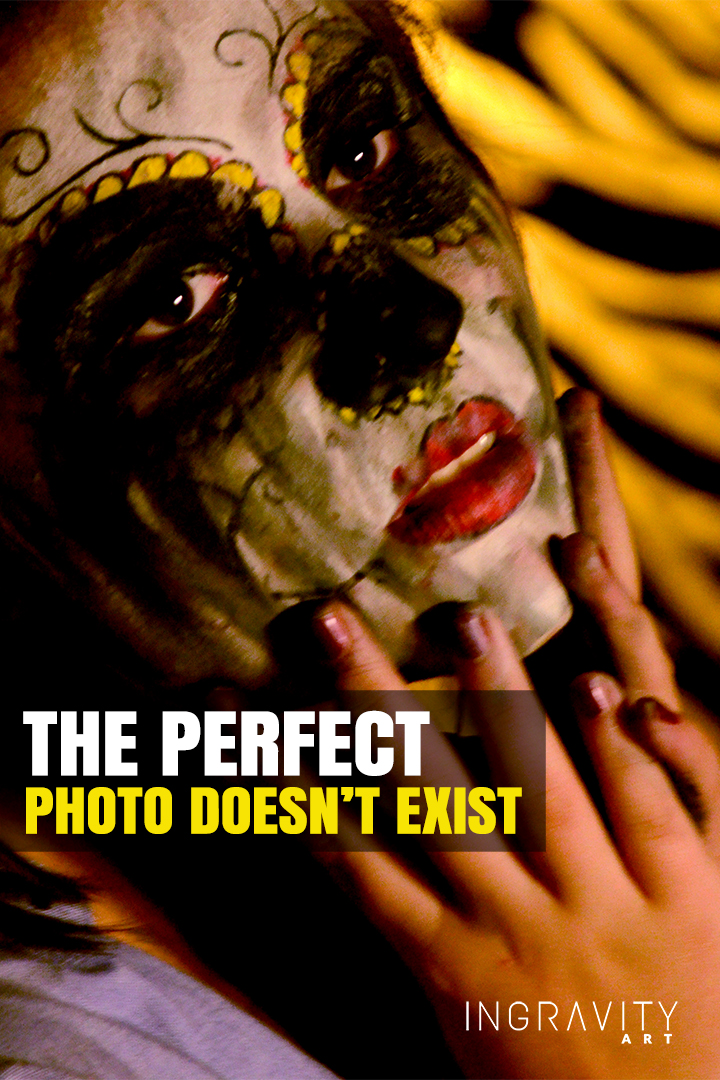
Or how photography became an international competition of zooming to 400%
By Jorge Javier Peña
The perfect photograph might be the greatest illusion modern photography ever created.
There’s a scene that happens on the internet every single day with the precision of a Swiss watch and the spiritual joy of a tax audit.
Someone posts a photograph. The image has something. Not necessarily perfection. Something worse: life. Maybe it’s blurry. Maybe it has grain. Maybe the exposure decided to leave the party without asking permission. But the photograph breathes. You stop. You look at it two seconds longer than usual. You feel something.
And then he appears.
The Forensic Critic.
“Nice attempt, but the focus is slightly off on the left eye.”
Life is full of people capable of ignoring a devastating photograph because they discovered microscopic digital noise in a shadow after zooming in as if they were searching for bacteria during a visual autopsy. The image could be talking about grief, memory, desire, fear, or the last time someone hugged their father before he died. But the conversation has already moved somewhere else. Now we’re all trapped inside an unsolicited seminar about peripheral sharpness and dynamic range.
The Myth of the Perfect Photograph
Welcome to the strange historical moment where some people love histograms more than photographs.
Somewhere along the way, the idea of the perfect photograph became more important than the emotional experience behind it. And honestly, it’s not entirely their fault. Photography was born with an existential crisis already built into it. From the very beginning, nobody could fully decide whether it was art, science, document, evidence, or simply an elegant way to make painters nervous.
Nineteenth-century pictorialists tried to make photography look like painting because the art world of the time needed cultural permission to take it seriously. Later came technical giants like Ansel Adams, developing control systems so precise they looked like aerospace engineering applied to mountains. Adams spent years perfecting the Zone System, a method for controlling tonal values with almost mathematical exactness. He could predict, before releasing the shutter, exactly how each shadow and highlight would behave in the final print.
But here’s the detail that gets lost in every YouTube review about his legacy: Ansel Adams did not master technique because he worshipped numbers. He mastered it because he needed to translate exactly what he felt standing in front of a landscape. The technique was language. A very precise, very demanding language. But language in service of something larger than itself.
Not religion. Not destination. Language.
Somewhere along the way, that got lost. And photography slowly began filling up with people more interested in evaluating images than actually looking at them.
Schools carry part of the responsibility. Not because they teach technique. Technique matters; it’s essential. The problem begins when technique becomes the spiritual center of the photographic experience, the thing the entire conversation orbits around.
Because teaching sensitivity is extraordinarily difficult. How do you evaluate presence? How do you grade intuition? How do you explain that strange instant when someone drops their guard in front of a camera for half a second, and suddenly a photograph appears that feels more discovered than taken?
That doesn’t fit easily into an academic rubric.
The rule of thirds does.
So we end up producing entire generations of technically flawless photographers capable of creating perfectly exposed images that generate the same emotional response as the instruction manual of a double-door Samsung refrigerator.
Extremely correct photographs.
Dead, but extremely correct.

Jazz, Imperfection, and the Photographers Who Understood
This is not a romantic defense of visual disaster. It is not an invitation to shoot blindly while screaming “art.” Authentic spontaneity is not technical ignorance. It’s technical freedom.
It’s jazz.
A musician who knows no music theory is not improvising. He’s lost. But someone who understands structure so deeply that they no longer need to think about it can finally let go and actually listen to what’s happening in the room, in the moment, between the notes.
Great photography works exactly the same way.
Henri Cartier-Bresson did not stop to mourn because a shadow contained grain. He was too busy recognizing the precise instant when geometry, light, and human movement aligned into something that would never happen again.
Robert Frank practically redefined modern photography with The Americans, a book that, when it was published in 1958, was received by part of the critical establishment with open hostility. The images were considered too dark, too raw, too unpolished. Frank photographed America as he actually saw it, not as it preferred to be seen. Crooked. Tired. Contradictory. Beautiful in ways that made people uncomfortable. Today, those same images are considered among the most important photographs of the twentieth century. The critics who dismissed them are footnotes. The work remains.
Daido Moriyama built an entire aesthetic from high contrast, extreme grain, radical blur, and images that many academic photography professors would fail before finishing their first breath. His work looks, by conventional technical standards, almost deliberately broken. And yet it communicates something about Tokyo, about urban life, about the body moving through a city, that no technically pristine image has ever managed to capture with the same visceral intensity.
The most dangerous photographers are not the ones who ignore the rules.
They are the ones who stopped living in terror of them.
What Imperfection Can Say That Perfection Cannot
There are things only imperfection can say.
A slightly blurred photograph can communicate anxiety better than a perfectly frozen one. Brutal overexposure can transform a body into pure memory. An “incorrect” backlight can make someone appear to dissolve into their own life, to exist at the edge of disappearing.
Technical perfection records.
The right imperfection interprets.
And that changes everything about what a photograph can do.
The Venezuelan Living Room Problem
I also believe that those of us who grew up in Venezuela, and probably across much of Latin America, understand this particular pressure in a very specific way.
There’s something deeply ours about the obsession with looking right. The ironed clothes before leaving the house. The living room perfectly arranged the moment visitors are expected, even while the rest of the house looks like the emotional survivor of a civil war. The endless “what will people think?” The permanent social performance. The exhausting, lifelong pursuit of the perfect appearance.
That same pressure exists in photography.
The image has to look correct before it is allowed to feel true. And during that process of correction, we often kill the exact thing that made the photograph alive in the first place.
Spontaneity rarely survives the obsession with pleasing everyone.
The Woman in Front of the Camera
This becomes even more obvious when photographing people.
A woman standing in front of your camera does not need a histogram scientist. She doesn’t need someone calculating depth of field while nodding intellectually like a recently ordained priest of Saint Adobe Lightroom Church. She needs human presence. She needs to feel that somebody is actually seeing her, not measuring her.
The best photographs of people rarely happen when everything is perfectly controlled. They happen when something real crosses the scene in the half second before the person puts the mask back on. When the performance slips. When the guard drops. When something true surfaces briefly and then disappears.
That lasts seconds. Sometimes less.
No plugin recovers an emotion you were never present enough to notice.
What Remains
That’s why the photographs that survive in memory are rarely the most technically perfect ones. They’re usually the ones containing something slightly broken. Something strange. Something that shouldn’t work and yet works precisely because of that. Images that continue existing emotionally long after the moment itself has disappeared.
Like people.
Because human beings are not perfectly exposed either.
We all have blown highlights, digital noise, motion blur, parts of ourselves we try to hide, moments out of focus, shaken emotions, overexposed memories, and fragments of life that no post-production can fully correct.
Maybe that’s why photographs that are too perfect sometimes feel so difficult to truly look at. So technically impressive and so emotionally distant.
Because life does not happen perfectly aligned.
Life happens fast.
Crooked, sometimes blurry, sometimes improvised.
Sometimes beautiful precisely because there wasn’t enough time to control it.
That’s why some images survive for decades while others disappear the moment the scrolling ends.
Not because they were perfect.
But because they were alive.
And in the end, nobody remembers the histogram, the dynamic range, ISO 50,000, or the 400% zoom.
People remember how an image made them feel.
And that, fortunately, still cannot be measured by Adobe Lightroom.
Jorge Javier Peña is a fine art and boudoir photographer based in Jacksonville, Florida. He is the founder of Ingravity Art, where he explores portraiture, identity, and the human presence in front of the camera.
Leave a Reply